

Disclaimer: While I am passionate about healthy living, this content about A2A2 milk is for informational purposes only and is not medical advice. I am not a healthcare professional, so please consult your doctor before making any major health or lifestyle changes.
One evening, I found myself caught up in the dairy milk section. My daughter had just turned 1, so I was on a mission to find the best, high-quality cow’s milk for her. Since I’m not usually a dairy milk–drinker myself (I tend to hover more in the world of plant-based milks due to digestive disagreements), this part of the store felt a little unfamiliar to me. But I was up for the challenge!
While browsing the rows of milks, something kept catching my eye: the labels “A2” and “A2A2”. I was seeing them quite a bit but don’t remember actually ever noticing them before. Some of the milk labels explained that this type of milk was apparently supposed to help with digestive issues.
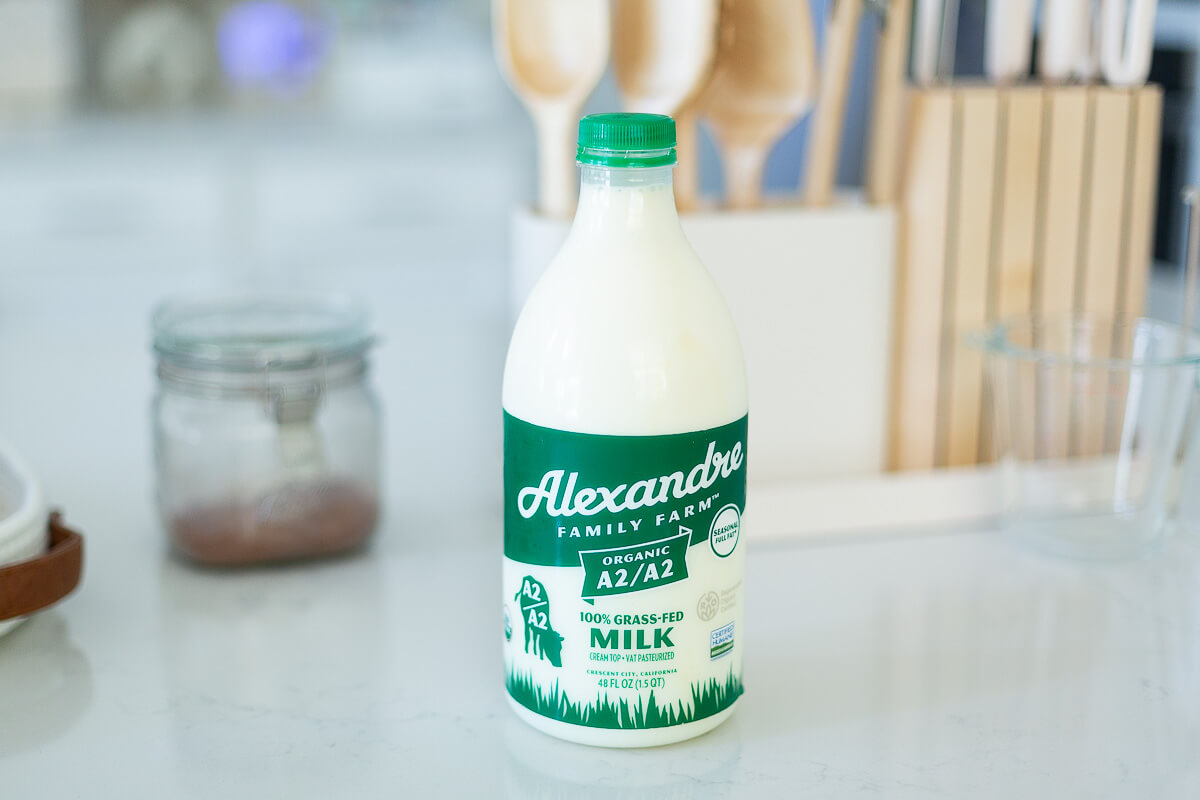
Honestly? My first thought was, “Great, another smooth marketing ploy.” All the other milks that claimed to help with digestive issues never worked for me. Lactaid. Organic lactose-free milks. Fairlife. Although, as I’ll touch on later, there could’ve been a lot of reasons why they didn’t work for me specifically (hint: lactose may not even be the culprit!).
I was about to completely ignore A2A2 until I noticed something interesting: many of the cartons and jugs labeled A2A2 were also regenerative, though not all of them. But enough to take note. I had actually done quite a bit of research on regenerative farming practices and knew how beneficial they were (assuming regenerative certifications reflect true regenerative practices). That detail nudged my curiosity just enough to want to give A2A2 milk a second glance.
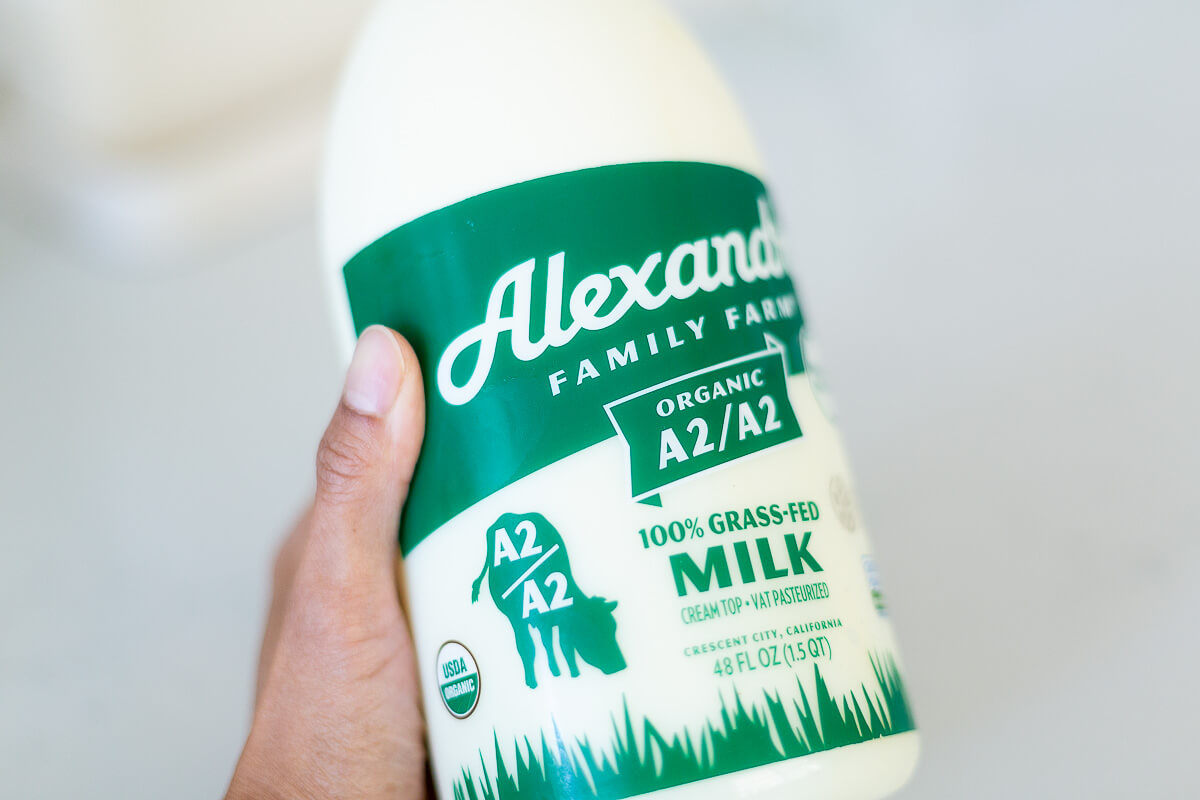
So I tossed an A2A2 milk into my cart (Alexandre Family Farm, to be exact). Mostly because it was regenerative, but still very curious about the A2A2 label. I was ready to dive in and uncover the truth and what A2A2 was all about.
Little did I know the vast amount of interesting and useful information I’d find. I can’t wait to bring you along on my A2A2 milk journey!
First of All, What Does A2A2 Even Mean?
Macronutrients at a Glance
Before diving into A2A2 specifically, let’s start with the basics so you can have a better idea of how it fits into the big picture.
A majority of what’s in cow’s milk is water; it makes up about 87% of milk. From there, cow’s milk is a mix of macro- and micronutrients. In this article, we’re just going to be talking about one of the macronutrients in milk—the protein. As you probably guessed, this is because A2A2 is a protein (Milk, 2021)!
Let’s Talk About A2A2 Milk & Its Protein Make-up
Have you heard of a protein in milk called casein? If so, you’re already one step ahead in understanding what A2A2 is.
Basically, milk contains two main types of proteins—casein and whey. We’ll be focusing on the casein.
The most common type of casein is beta-casein. And from there, beta-casein can either be A1 and A2.
In a nutshell, A2A2 is one gene variant of the protein beta-casein. The other variants include A1A1 and A1A2. Think of A1 and A2 as the beta-casein traits, and A1A1, A1A2, and A2A2 as the label for how those traits are expressed. While most cows milk contains about equal proportions of A1 and A2 beta-casein protein, A2A2 milk is a 100% A2 variant (Ho et al., 2014; A2 Milk and A2 Genetics, 2022).
In a nutshell, here’s what the difference is between A1A1, A1A2, and A2A2. It’s probably just what you’d expect, but I just wanted to lay it out in this table to make it easy for you to glance at:
| Gene Variant Name/Label | Beta-Casein Protein Make-up in Milk (Their Gene Expression) |
|---|---|
| A1A1 | Cow’s milk is made up of 100% A1 beta-casein protein. |
| A1A2 | Cow’s milk is made up of some mix of A1 and A2 beta-casein protein. |
| A2A2 | Cow’s milk is made up of 100% A2 beta-casein protein. |
How is A2A2 Milk Made?
From DNA Testing to Carton Label
Producing A2A2 milk starts at the genetic level. All cows produce beta-casein proteins, but not all cows make the same type. Each cow carries two copies of the beta-casein gene, and these can be (as shown above in the table):
- A1A1 (produces only A1 beta-casein)
- A1A2 (produces a mix of both A1 and A1 beta-casein)
- A2A2 (produces only A2 beta-casein)
To create milk that contains only A2 beta-casein, dairy farmers first have to identify which cows in their herd carry the A2A2 genetic profile. They do this using a simple DNA test usually using a hair or tissue sample sent to a lab. After confirming which cows carry the A2A2 gene, farmers can selectively breed them with A2A2 bulls to gradually increase the number of cows with this trait.
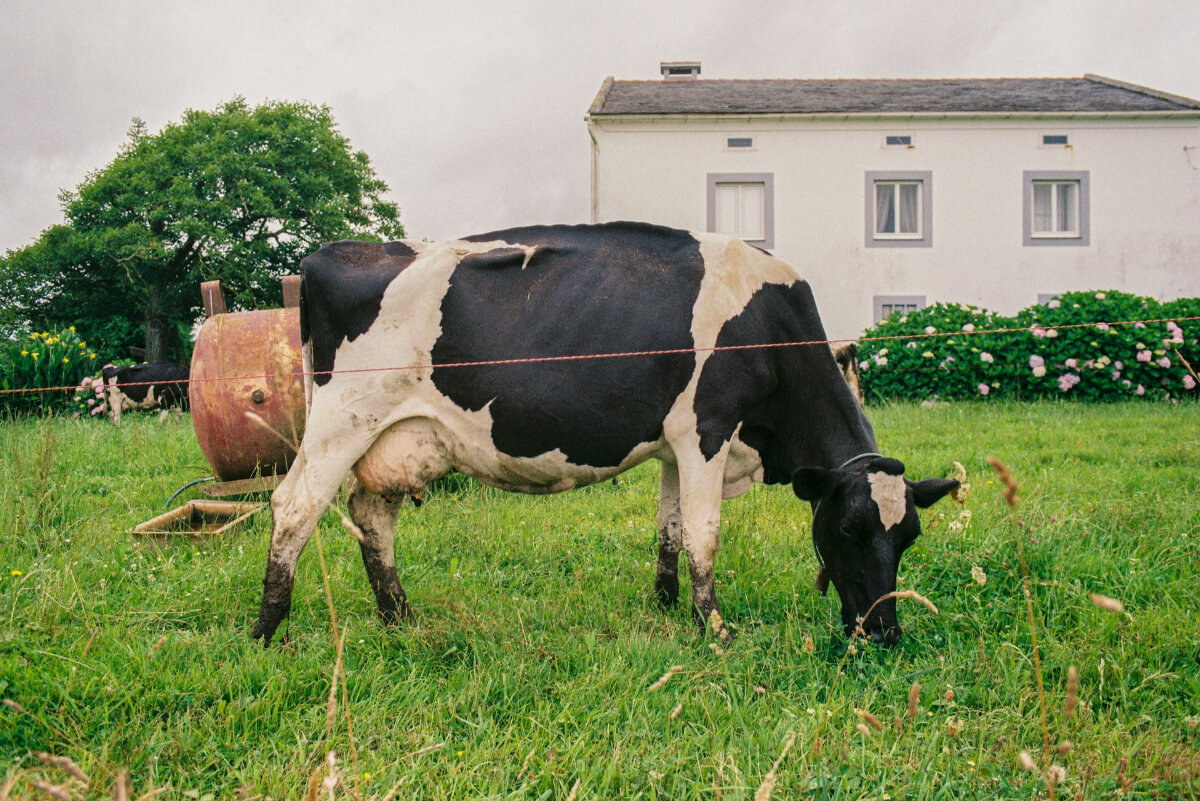
Over time, herds can shift to entirely A2A2 genetics. Certain heritage breeds, such as Guernsey and Jersey cows, already have a profile that leans more toward A2. However, Holstein cows, the most common U.S. dairy breed, often require more careful selection since they tend to carry both A1 and A2 genes (Milk, 2021; A2 Milk and A2 Genetics, 2022).

Pure Persective: A2 vs. A2A2: What’s the Difference?
If you’ve ever wondered why some milk cartons say “A2” and others say “A2A2,” you’re not the only one. Basically, they are both the same! Scientifically speaking, “A2A2” is actually the more accurate term. It refers to the specific beta-casein gene expression in the cow (see the table above). But here’s something interesting: “A2 Milk” is a trademarked term owned by The A2 Milk Company™. That means only licensed partners can use the “A2” label, even if other producers are selling the exact same kind of milk from A2A2 cows.
Some small farms, like Miller’s Bio Farm, were even forced to relabel their milk from “A2” to “A2A2” to avoid legal trouble, despite absolutely nothing changing about their cows or their milk. It’s a good reminder that label language can sometimes be the result of business decisions and marketing.
Once collected, the milk from A2A2 cows is kept separate and processed in facilities that maintain its purity. That’s what allows it to be sold with that official A2A2 (or A2) label!
Why Does A1 vs. A2 Even Matter?
Milk Allergies & the A1A2 Connection
Now that we know A2A2 is simply one variant of the beta-casein protein in cow’s milk, the next big question is: why does this even matter?
To answer that, it first helps to look at how our bodies (specifically, our immune and digestive systems) respond to proteins in milk.
A Quick Note About Lactose Intolerance (Carb Reaction) vs. Milk Allergies (Protein Reaction)
When you hear about people having stomach problems from drinking milk, you’ve probably most commonly heard them say something about lactose intolerance. That refers to the body’s inability to digest the sugar lactose in milk (so a carbohydrate, not a protein). I just wanted to address that and set it aside so we can now focus on what we’re really here for—the proteins!
Not All Milk Allergies Are Created Equal
A lot of people don’t realize that milk protein allergies can also trigger stomach issues, not just lactose intolerance. Milk allergies are immune responses to one or more of the hundreds of proteins present in milk (Ho et al., 2014).
Pure Insight: Allergies, in general come in two main forms: IgE and Non-IgE. IgE-mediated reactions are immediate and more serious. These include hives, swelling, difficulty breathing, and can lead to anaphylaxis. Non-IgE-mediated reactions are delayed, subtler, and often affect digestion or the skin. Think bloating, eczema, or colicky symptoms in infants (Homesteady & Paullin, 2023).
Here’s where A2A2 comes in. According to molecular biologist and founder of Free to Feed Dr. Trillitye Paullin, a pretty sizable number of people (about 25–33% of the population according to the most recent data she referenced in 2023) have allergic reactions specifically to the A1 beta-casein protein found in most conventional milk. These reactions are often non-IgE in nature, so their symptoms are easy to confuse with those of lactose intolerance or even just dismiss (Homesteady & Paullin, 2023).
What Happens When People Have Allergic Reactions to A1 Beta-Casein?
When A1 beta-casein is digested, it produces a peptide called beta-casomorphin-7 (BCM-7), which has been linked in some studies to inflammation, slower digestion, and gut discomfort (Milk, 2021). On the other hand, A2A2 milk produces way less BCM-7, making it potentially easier to digest for those who have non-IgE allergies to A1 beta-casein (Ho et al., 2014).
Will A2A2 Milk Help Me?

All of this is great to know, but here’s the big question you’re probably asking and really want the answer to—will A2A2 milk help me?
The annoying answer is—maybe!
Let me explain.
Remember how I mentioned above that there are hundreds of types of proteins in milk? Well, A2A2 milk is a modification of just one of those hundreds of milk protein types. So if your symptoms are caused by other milk proteins other than A1 beta-casein or if you have a confirmed IgE-mediated milk allergy, A2A2 milk won’t help.
That being said, beta-casein makes up a pretty sizable percentage of proteins in milk. Casein itself makes up 80% of all milk proteins, and beta-casein makes up 30% of that 80% (Ho et al., 2014; A2 Milk and A2 Genetics, 2022). And as Dr. Trillitye Paullin stated, about a quarter to a third of people do have allergies to A1 beta-casein. So by making that one protein more tolerable, this could be a godsend for many people who struggle with non-IgE-mediated milk allergies to A1 beta-casein (Homesteady & Paullin, 2023).
Pure Tip: Curious About A2A2 Milk? Try a Simple Experiment
If you’re thinking of giving A2A2 milk a shot, try introducing it slowly. Start with a small amount, keep a simple journal of how you feel (especially over 24–48 hours), and note any changes in digestion, skin, or energy. When in doubt, talk to a healthcare provider who understands both IgE and non-IgE food allergies.
Should I Buy A2A2 Milk and Try It Out?
If you are okay with the possibility that the milk may not work for you (and potentially dealing with the aftermath), then there is certainly no harm in trying it out. Best case scenario, you find your answer to enjoying dairy again! Worst case scenario, don’t buy it again and go back to your tried and true dairy-free alternatives.
As for me, I gave A2A2 milk a try. And while it wasn’t the solution in my case, that doesn’t mean it won’t be for you. Every body is different, and we each have to figure out what works best for us.
A Note About Ethics Declaration & Conflict of Interests
Something I want to point out about the Ho et al. (2014) study I cite in this article about effects of A1A2 vs. A2A2 milk is that two of the authors actually work in the A2 industry.
This quote is directly from the source article:
“Dr Sonja Kukuljan is a salaried employee of A2 Dairy Products Australia. Professor Keith Woodford consults to A2 Corporation as an independent scientific adviser. The remaining authors declare no conflict of interest.”
I always read conflict of interest sections in scientific journals just to get a better idea of context.
Does this mean that the data is all false? Not at all. I don’t believe in throwing the baby out with the bath water. But I do think it’s important to keep these things in mind when interpreting results, especially in emerging or debated areas like this one. Transparency is key, and you deserve the full picture when making decisions about your health!
Personally, I’d love to see more research on this topic in general, but especially from scientists who have no affiliation with the A2 industry. That being said, I am glad that we at least have a starting place.
Wrapping It All Up: So, Is A2A2 the Answer?

A2A2 milk may not be a magical fix for everyone. But for some, it could offer genuine relief.
If you’ve struggled with digesting dairy and have ruled out lactose intolerance, it may be worth exploring whether an A1 beta-casein, non-IgE-mediated allergy is behind your symptoms. However, since A2A2 milk only addresses one specific type of milk protein (not all of them), it’s important to understand that it won’t be the answer for everyone. For the 25–33% of people who have a sensitivity specifically to A1 beta-casein though, switching to A2A2 could be a game-changer!
Have you tried A2A2 milk? If so, did you have success with it? I’d love to hear your experience. Feel free to share it in the comments below!
If you’re curious about exploring how to better tune into your body’s needs in other ways, take a look at the Present & Pure Healthy Living guide. It’s full of empowering insights to help you feel more connected, informed, and supported on your healthy living journey!
References & Scientific Sources
A2 milk and A2 genetics. (2022). University of Minnesota Extension. Retrieved July 18, 2025, from https://extension.umn.edu/dairy-milking-cows/a2-milk-and-a2-genetics
Ho, S., Woodford, K., Kukuljan, S., & Pal, S. (2014). Comparative effects of A1 versus A2 beta-casein on gastrointestinal measures: a blinded randomised cross-over pilot study. European Journal of Clinical Nutrition, 68(9), 994–1000. https://doi.org/10.1038/ejcn.2014.127
Homesteady, & Paullin, T. (2023, April 20). Is Cow Milk Making Me Sick? Will Raw A2A2 Milk Fix it? [Video]. YouTube. Retrieved July 18, 2025, from https://www.youtube.com/watch?v=-mYywV5aFHo
Milk. (2021, July). The Nutrition Source | Harvard T.H. Chan School of Public Health. Retrieved July 19, 2025, from nutritionsource.hsph.harvard.edu/milk/

0 Comments